Reykjavík
- Cloud cover
- Loading…
- Aurora activity
- Loading…
- Viewing conditions
- Loading…

Cloud cover shows the expected local sky conditions. Aurora activity describes the expected auroral strength assuming clear, dark skies. Viewing conditions combine the two to indicate how favourable the location is for actually seeing the Northern Lights.
Loading forecast…


Seeing the Northern Lights in Iceland depends on three things coming together: a dark sky, a clear view through the clouds and aurora activity. A promising aurora forecast is useful, but the weather where you are standing can decide whether you see anything.
Use the regional forecast above to compare cloud cover and aurora potential, then explore the cloud map for your planned viewing time. Conditions can differ between regions and change during the evening.
The viewing season generally runs from late August into April, when nights become dark enough to reveal the aurora. Winter offers longer hours of darkness, but no month guarantees clear skies or a display. During the bright summer nights, the sky is generally too light for Northern Lights viewing.
The season’s beginning and end depend on the date, location and brightness of the aurora. Darkness changes quickly during spring and autumn.
Yes. Northern Lights can be visible from Reykjavík when skies are clear and activity is strong enough. Streetlights make faint displays harder to distinguish, so a darker location with an open view can help.
Leaving the city is useful when it takes you towards clearer skies or away from bright lighting. Travelling farther does not automatically improve your chances: check the cloud forecast before choosing a direction.
The most useful location is somewhere with clear, dark skies that you can reach safely. A famous viewpoint offers little advantage if it is covered by thick cloud.
Compare the regional cards, then look more closely at the cloud map. Those cards describe forecast regions rather than the exact sky above every town or viewing spot. Check local weather and road conditions before travelling, and choose a suitable place to stop. Consider booking a tour.
No. Kp describes geomagnetic activity on a planetary scale; it is not a yes-or-no prediction for your location. Your position relative to the aurora matters, and a higher number does not remove the need for darkness and clear skies.
Read Kp alongside the other conditions rather than using it as the only reason to go out or stay inside.
Use forecasts to plan, then check again closer to your viewing time. Cloud forecasts and space-weather forecasts cover different periods and have different uncertainties.
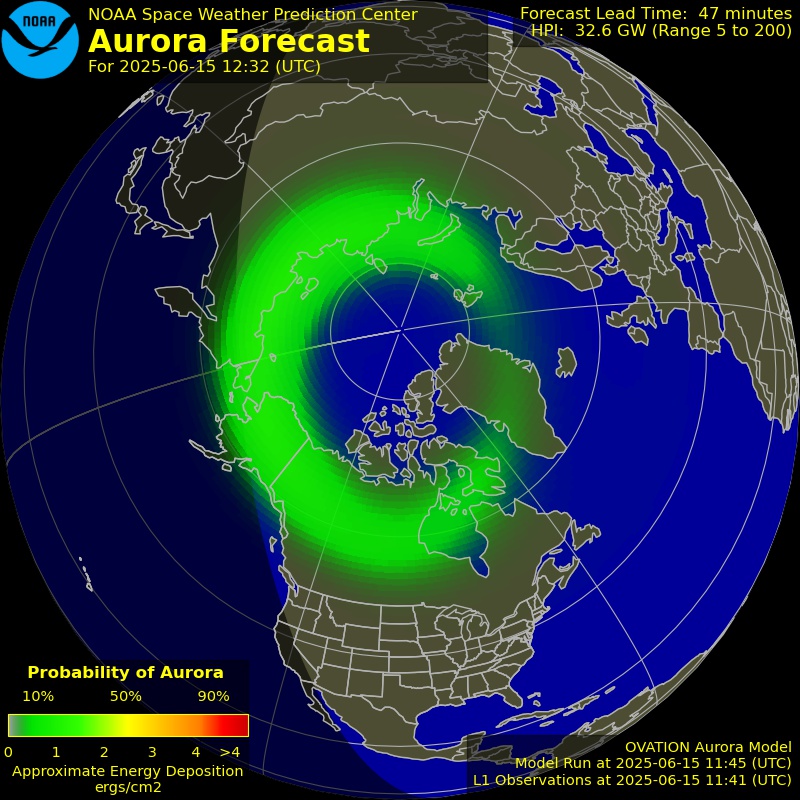
The NOAA aurora oval shown above usually looks around 30–90 minutes ahead. Moving the cloud slider to tomorrow does not move the aurora oval to tomorrow as well. Always check the time on each map, and remember that favourable conditions offer an opportunity rather than a guaranteed sighting.